
Back in the day, before the rules changed in October 2017, a Category C (Cat C) car was an insurance write-off where the repair bill was actually higher than the car's market value. If you're in the motor trade, seeing a 'Cat C' marker on a vehicle's history is a major heads-up. It tells you this car has been through a significant trauma and, even though it was deemed repairable, it comes with a history that affects its value and how buyers see it.
What Does Cat C Actually Mean for a Used Car?
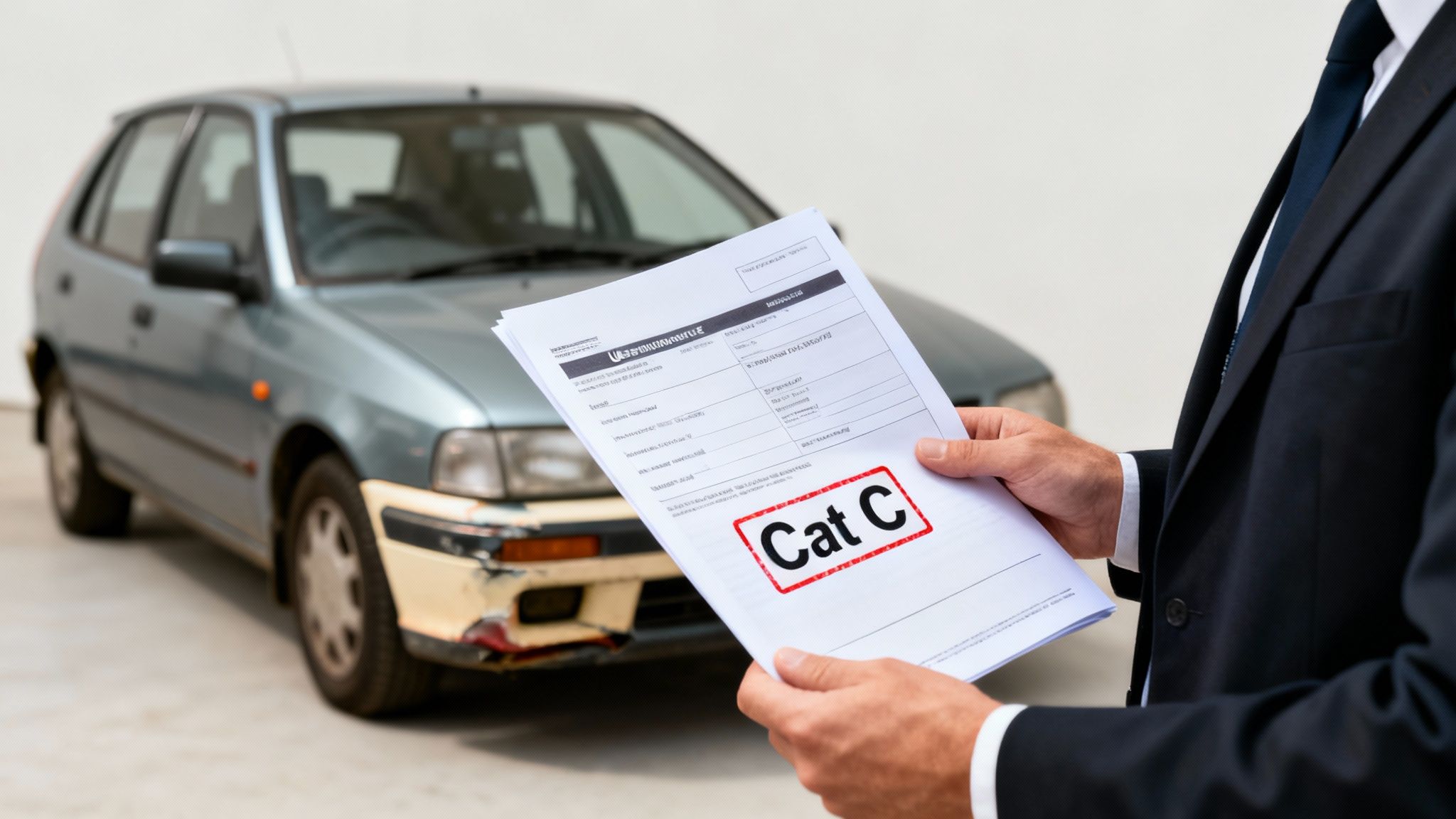
When you're appraising a part-exchange or sizing up a vehicle at auction, that ‘Cat C’ marker still carries a lot of weight. It’s a ghost from the past that tells a story of serious damage, a story where an insurer crunched the numbers and decided it was cheaper to just pay out the owner rather than foot the bill for repairs.
Picture this: a car worth £4,000 has a prang, and the garage comes back with a repair quote of £4,500. For the insurance company, that’s a straightforward economic loss. They’d write it off, slap a Cat C marker on its record, and settle the claim. The car would then typically be sold for salvage, often finding its way back onto the market via auction.
A Purely Economic Decision
The key thing to remember about the cat c car meaning is that the decision was purely financial. It wasn't always about the severity or type of damage. While plenty of Cat C cars had suffered structural damage, the label was triggered simply because the repair bill tipped over the car's pre-accident value (PAV). That distinction is absolutely crucial for any trade professional to understand.
A car could end up as a Cat C write-off for all sorts of reasons, not just a massive smash. For example, older, low-value vehicles could be written off for a simple front-end knock needing new headlights, a bumper, and a bonnet. On a car worth little to begin with, that could easily push the repair cost over its market value. Likewise, damage to cars with pricey components, like sophisticated electronics or specialist body panels, could also trigger a Cat C classification, even if the main structure was perfectly fine. Finally, sky-high labour rates at approved repair shops could inflate an estimate so much that writing the vehicle off became the only sensible financial move for the insurer.
For a motor trade professional, a Cat C marker is a critical flag. It's not necessarily a deal-breaker, but it means you've got to dig a lot deeper to figure out the car's true condition and what it's really worth.
This bit of history is so important because there are thousands of these cars still out there on the used market today. Even though the system changed in 2017, that Cat C designation stays on a vehicle's record for life. Uncovering a vehicle's past is your first job, and an instant AutoProv check is the only way to get the solid data you need to properly assess the risk and the opportunity.
The Shift from Cat C to Cat S Write-Offs
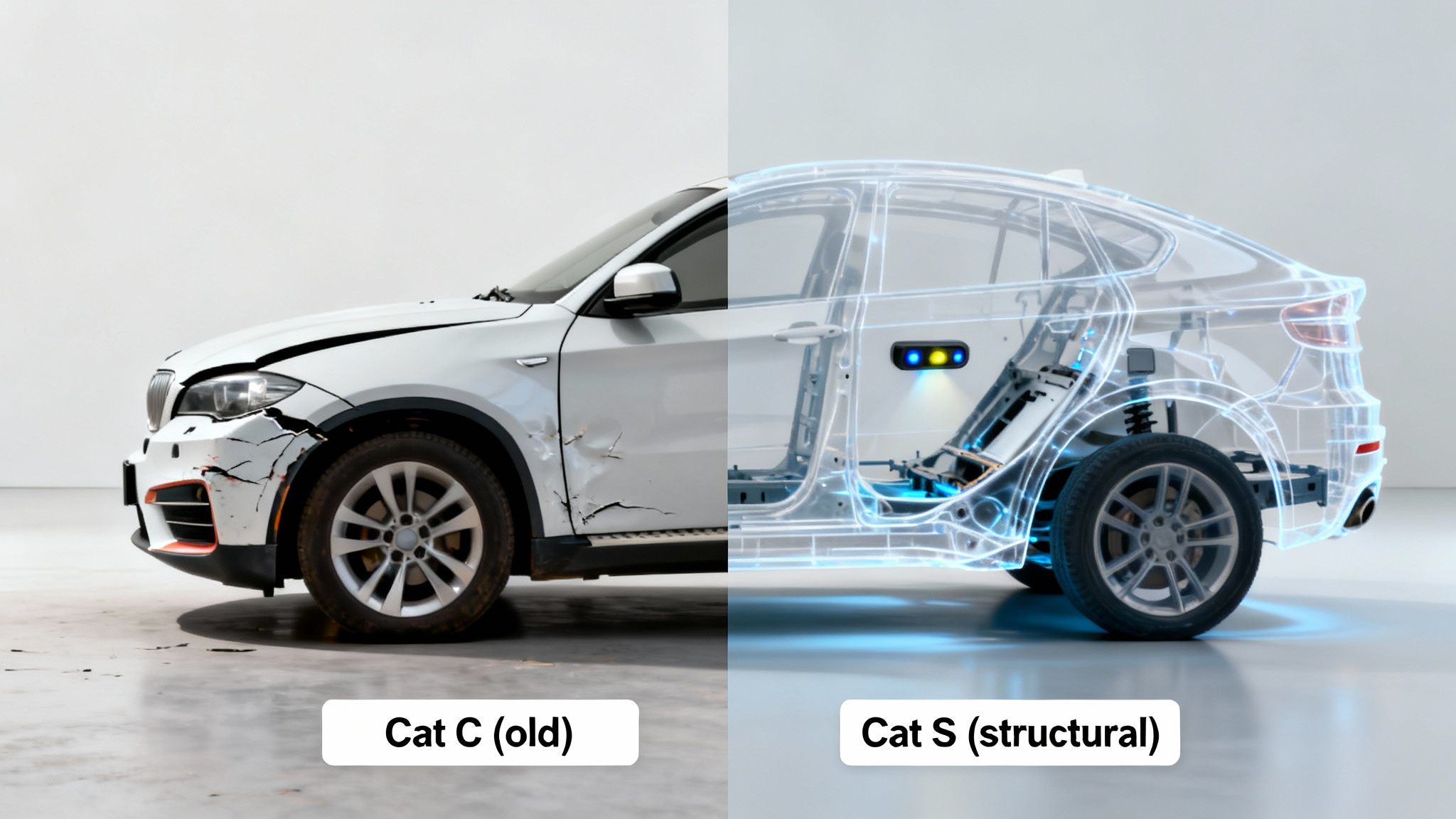
To get a real grip on the used car market today, you have to understand where it came from. The game changed completely back in October 2017 when the Association of British Insurers (ABI) overhauled the salvage code. This was the moment the old Cat C and Cat D system was retired, making way for the Cat S and Cat N categories we use now.
This wasn’t just a case of slapping new labels on old tins. It was a crucial evolution, pushed forward by the sheer complexity of modern cars. As vehicles became loaded with sophisticated electronics and advanced driver-assistance systems (ADAS), the old-school way of deciding what made a write-off simply stopped making sense.
Why the Old System Became Obsolete
The old Cat C marker was all about the money. If the cost to repair a car was more than its pre-accident value, it was branded a Cat C. Simple. For decades, this system worked just fine, but it started to buckle under the weight of spiralling repair costs for newer vehicles.
Let’s paint a picture. You’ve got a nearly new hatchback on the forecourt with a pre-accident value of, say, £8,000. It takes a relatively light knock to the front, nothing that even touches the chassis. But that knock smashes an adaptive LED headlight unit, cracks a bumper full of parking sensors, and throws the forward-facing radar for the cruise control out of whack.
Suddenly, the bill for those high-tech parts and the specialist labour to fit and recalibrate them is pushing £8,500. Under the old rules, that car is now a Cat C write-off. This label screamed 'severe damage' to buyers, when the reality was its structural integrity was perfectly fine. The system was painting a completely misleading picture for the trade.
The real problem was this: the old categories cared about the cost of the repair, not the type of damage. The industry desperately needed a system that could tell you if you were looking at a cosmetic and electronic fix or a serious structural problem.
By 2017, this issue of 'write-off inflation' was getting out of hand. Some industry insiders reckoned that advanced repair costs were unnecessarily writing off an extra 15-20% of vehicles every year. The move to a new system was all about bringing back some much-needed transparency about a vehicle’s true condition.
Contrasting Cat C with its Successor Cat S
The new system cuts right to the chase, fixing the old one's biggest flaw by focusing on the type of damage, not the price tag. For anyone in the motor trade, this gives a much clearer, more honest initial assessment.
The fundamental difference is that a Cat C marker indicated an economic write-off, where the repair bill was higher than the car's value, regardless of the damage type. In contrast, a Cat S (Category S) marker signifies a structural write-off, meaning the vehicle has sustained damage to its core frame or chassis, full stop. The repair cost is irrelevant to the Cat S categorisation.
This distinction is absolutely vital. A Cat S marker tells you from the get-go that the vehicle has had serious, structural surgery. A Cat C might have had structural damage, but there was no guarantee. For a deeper dive, check out our guide on what is a Cat S write-off in the UK.
Even today, thousands of Cat C vehicles are still circulating in the used market. That’s why using a tool that understands both the old and new systems is non-negotiable. An AutoProv report effortlessly translates historical Cat C data alongside modern Cat S/N records, giving you the complete, accurate provenance you need to make a confident appraisal.
How a Cat C History Impacts Your Bottom Line

Knowing the definitions is one thing, but the real question is how a Cat C history actually hits your profit margin when that car lands on your forecourt. The commercial impact is instant, touching everything from your initial appraisal and pricing right through to the customer's insurance and the car’s eventual resale.
For any professional in the motor trade, a Cat C marker screams "high-risk, high-reward." Sure, the potential for a bargain is huge, but so is the chance of buying a car that becomes a financial black hole. Getting this right takes more than just a gut feeling; it demands cold, hard data from a service like AutoProv.
This is where the theory smacks into reality. It doesn’t matter if you're an independent dealer eyeing up a potential steal at auction or a main dealer appraising a tricky part-exchange – a Cat C history completely changes the game.
The Immediate Hit on Resale Value
The most direct punch to your profits from a Cat C record is a massive drop in the car’s market value. We’re not talking about a small dent here; the depreciation is severe and it’s permanent. A car with a Cat C marker will typically be worth 20% to 40% less than an identical, straight model.
Think about a popular hatchback that normally retails for £10,000 in good nick. The moment it gets that Cat C history, its realistic selling price plummets to somewhere between £6,000 and £8,000. That’s even if the repairs are absolutely flawless. This devaluation is a permanent stain on its record that you have to account for.
In the UK used car market, Category C cars have been a hot topic for years. They represent vehicles where repair costs, at the time, were simply more than the car was worth. Before the system changed on 1 October 2017, this was a purely economic decision, meaning thousands of repaired cars hit the market every year, often snapped up at trade auctions for a fraction of their retail price.
Insurance Headaches for Your Future Customers
Another major hurdle you’ll face is insurance. While it's perfectly legal to insure and drive a repaired Cat C car, many of the big insurance companies get nervous and won’t touch them. The ones that do will almost certainly ramp up the premium.
This creates a huge barrier to sale. A potential buyer might love the car and the price, but if they get quoted an outrageous premium—or are flat-out refused cover—the deal is dead in the water. It’s a classic scenario that adds yet another layer of difficulty to shifting Cat C stock.
The challenge isn't just selling a car; it's selling a car that a customer can actually afford to run. A high insurance quote can kill a deal just as effectively as a dodgy gearbox.
As a dealer, you have to bake this into your appraisal from the start. The vehicle is simply less desirable, not just because of the old damage, but because of the ongoing costs and hassle it puts on the next owner.
Pricing with Precision, Not Guesswork
This is where having the right data becomes non-negotiable. Trying to guess the value of a Cat C car is a recipe for disaster. Price it too high, and it’ll sit on your forecourt gathering dust. Price it too low, and you're just giving away your profit.
An AutoProv report cuts right through this uncertainty. It gives you the crucial data points you need to make a smart, calculated business decision, such as detailed MIAFTR condition records and precise market valuations. This means you’ll instantly see the official write-off record from the Motor Insurance Anti-Fraud and Theft Register, confirming the exact date and category. You also get access to both trade and retail pricing that accurately reflects the car's history, letting you appraise with total confidence.
Armed with this information, you can turn what looks like a financial minefield into a genuinely profitable opportunity. The hard data means you can confidently set a purchase price that protects your margin and a retail price that is fair, competitive, and reflects the vehicle’s true place in the market.
Getting a Cat C Car Legally Back on the Road
Handling a Category C vehicle isn't just about good workshop practice; it's a legal minefield for any motor trade professional. Getting it right means protecting your business, your reputation, and most importantly, your customers. This process is far more than a simple repair job—it demands a flawless paper trail and a serious commitment to due diligence.
The Old Way: The VIC Check
Let's turn back the clock for a moment. Before the current system, getting a Cat C car back on the road was a bit more involved. These vehicles had to go through a mandatory Vehicle Identity Check (VIC). This was a DVSA-led inspection, and its main job was to confirm the car's identity by matching its VIN to the registration documents. The goal was simple: to clamp down on cloning and ringing.
But things change. The VIC scheme was officially scrapped in October 2014 after it was found to be pretty ineffective at actually tackling vehicle crime. While this made the process simpler on paper, it shifted a huge amount of responsibility onto the shoulders of the repairer and the seller to prove a vehicle is genuinely roadworthy.
Today's Legal Requirements
Now, the official path for a repaired Cat C car is much more direct. Once the repairs are done and the vehicle is safe, it absolutely must pass a standard MOT test. This isn't a friendly suggestion; it's a non-negotiable legal requirement.
Think of the MOT certificate as the official green light. It confirms the car meets the minimum safety and environmental standards for UK roads. Without a fresh MOT, the car can't be legally driven, taxed, or insured. End of story.
Once it has a new MOT, the next step is getting the paperwork straight with the DVLA. The V5C logbook must be updated to reflect the car's history. It will be officially stamped with the words: "This vehicle has been salvaged and repaired and/or declared a total loss for insurance purposes."
This permanent note on the V5C is absolutely critical. It provides total legal transparency, making sure any future owner knows exactly what they’re buying. For you as a dealer, disclosing this isn't just good form—it's your legal duty.
But here’s the catch. A clean MOT and an updated V5C are just the beginning of the story. All they really prove is that the car passed a basic safety check on one particular day and that its history has been recorded. They offer zero validation of the repair quality. A shoddy, rushed repair job could easily scrape through an MOT, hiding serious structural or mechanical problems just beneath the surface.
This is exactly where you need to bring in professional-grade data. Before you even think about lifting the bonnet, an AutoProv report lets you trace the vehicle's entire documented journey. By checking our comprehensive MOT history checker against DVLA data, you can confirm the exact timeline of the write-off, spot any dodgy gaps in its history, and see a full list of advisories. This first digital step is essential—it gives you the hard evidence to proceed with confidence, or to walk away before you make a costly mistake.
Your Provenance Checklist for Cat C Vehicles
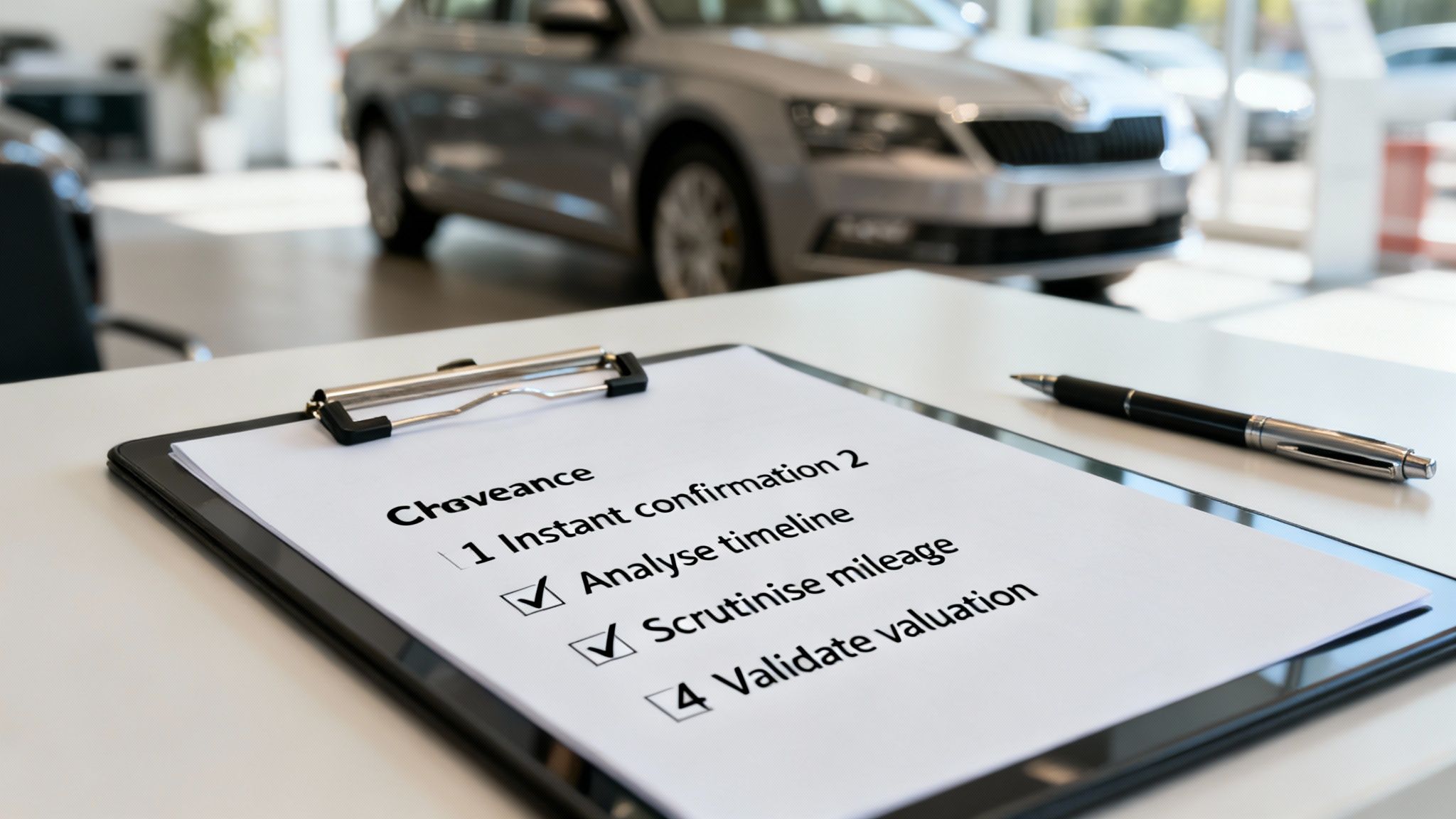
When a car with a potential Cat C past lands on your forecourt, either at auction or as a part-exchange, you need to make a quick, accurate call. Guesswork costs money. A methodical approach, on the other hand, backed by solid data, protects your margin and your reputation.
Think of this as your battle-tested workflow for de-risking any vehicle with a legacy write-off marker. It’s about turning uncertainty into a clear ‘buy’ or ‘walk away’ decision in seconds, using the data inside an AutoProv report. This isn't just a list of things to do; it's a systematic process designed to uncover the full story behind the marker, turning a potential liability into a calculated asset.
Step 1: Instant Confirmation
First things first: get the facts straight. Don't rely on the seller's word or a quick glance at the V5C. Run the vehicle's registration through the AutoProv platform and head straight for the 'Salvage and Write-Off' section of the report.
You need instant, definitive proof from the source. The report pulls data directly from the Motor Insurance Anti-Fraud and Theft Register (MIAFTR), showing you the exact date the vehicle was written off and confirming its Category C status. This single piece of information is the bedrock for every other check you're about to make.
Step 2: Analyse The Timeline
With the Cat C status confirmed, the next job is to put that event into context. The write-off date in the report is your anchor point. Now, you need to cross-reference this with the vehicle's DVLA MOT history, which is also laid out clearly within your AutoProv report.
What you're looking for are anomalies—the bits that don't add up. Pay close attention to the period immediately after the write-off incident. A long, unexplained gap between the write-off date and the next MOT can be a major red flag, hinting at a prolonged or particularly troublesome repair.
On the flip side, scrutinise the advisories and failure points on the first MOT after the repair. Do they line up with the likely area of damage? For instance, persistent advisories for suspension parts or uneven tyre wear on one side could point to underlying chassis issues from the original smash that were never properly sorted.
A vehicle's timeline tells a story that paperwork alone can't. By comparing the write-off date to MOT records, you can spot the narrative gaps that often hide the biggest risks. This is a core part of any professional provenance check for a used car.
Step 3: Scrutinise The Mileage
A write-off history can sometimes be a smokescreen for other shady practices, and mileage tampering is a common accomplice. Think about it: a significant period off the road for repairs provides the perfect opportunity for a dishonest seller to "clock" the vehicle. Your AutoProv report is your best defence here. It pulls together data from multiple trusted sources, including DVLA MOT history, service records, and MIAFTR data.
By laying these different data streams side-by-side, you can spot discrepancies in a heartbeat. A sudden drop in mileage or a reading that just doesn't logically fit the MOT timeline is a clear warning sign that needs a much closer look.
Step 4: Validate The Valuation
At the end of the day, it all comes down to the numbers. A Cat C car has to be priced right to make sense for your business. Using AutoProv's precise market pricing data is the final, crucial step in your assessment. The platform gives you both trade and retail valuations, already adjusted to reflect the vehicle's history.
This is how you know if the seller's asking price is realistic. Legacy Category C cars are a staple of the UK motor trade, but their presence demands careful appraisal. An informed valuation stops you from overpaying for an asset with built-in risk.
By following this four-step process, you're not just looking at a report; you're executing a data-driven strategy to assess risk, verify the history, and make a confident, profitable decision every single time.
Protect Your Margin with Confident Appraisals
Getting your head around the old cat c car meaning and its modern Category S equivalent isn't just about knowing the lingo; it's fundamental to protecting your bottom line. As we've seen, these vehicles come with a unique set of risks—devalued assets, insurance headaches for your future customers, and sometimes, lingering safety concerns.
Of course, we've also established that buying a Cat C (or S) vehicle can be a savvy, profitable move. But this only holds true when you've got irrefutable, professional-grade data on your side to shape your appraisal. This data is what turns a potential gamble into a calculated business decision.
From Data Tool to Risk Partner
The main takeaway here is simple: you can no longer afford to fly blind and rely on gut feeling alone. An instant, comprehensive provenance check has to be a non-negotiable part of every single appraisal you do. It's how you protect your capital, stay on the right side of the law, and keep your edge in a market that never stands still.
AutoProv is not just a data tool; it is an essential risk management partner for any serious motor trade professional. By providing instant clarity on a vehicle's history, it allows you to price with confidence and operate with certainty.
This proactive approach is everything. Without a detailed history check, for instance, you could easily overpay for a vehicle with a hidden past, wiping out your profit margin before the car even hits your forecourt. The data inside an AutoProv report lets you accurately factor in the typical 20-40% value reduction of a write-off, making your offer precise and easy to justify.
This level of due diligence is standard practice for seasoned traders. For a complete rundown of the process, you can find more information in our practical guide covering HPI checks for traders.
Ultimately, baking these checks into your daily workflow is the single most effective way to safeguard your investments. It gives you the power to turn potential liabilities into profitable stock, safe in the knowledge that every purchase is backed by complete, verifiable vehicle intelligence.
Frequently Asked Questions
Getting to grips with a vehicle's history is part of the daily grind for any motor trade professional. Even though Category C is an older term, seeing it on a vehicle's record still throws up plenty of questions. Here are some straight, trade-focused answers to the queries we hear most often about the cat c car meaning and what it means for your business.
Can I Legally Buy and Sell a Car Recorded as Cat C?
Yes, absolutely. There's nothing illegal about buying, repairing, and selling a Category C vehicle. The law is focused on two things: safety and transparency. It's not about banning these cars from the road.
As long as the vehicle is repaired to a safe, roadworthy standard and has a current MOT, you're good to go. The most important thing is that you must be completely upfront about its history with the next buyer. The V5C logbook will be marked, and you have to declare it. Hiding this information is a fast track to serious legal trouble.
An AutoProv report gives you undeniable proof of the vehicle's write-off status. This helps you price it right and ensures you've got the disclosure covered for a fully compliant, ethical sale that protects your business and your customer.
How Does a Cat C Record Affect a Vehicle's Trade Value?
A Cat C marker hits a vehicle's value, and it hits it hard. A good rule of thumb for anyone in the trade is to expect a Cat C car to be worth 20% to 40% less than the same model with a clean history.
Of course, the exact drop can vary. It depends on things like the car's age, how desirable it is in the current market, and—most crucially—the quality of the repairs. You need to be able to see and verify that the work was done to a high standard.
This is where having the right data makes all the difference. AutoProv's built-in market insights, which include both trade and retail valuations, are a game-changer when you're appraising one of these. This live data helps you work out an accurate offer, stopping you from overpaying on a part-ex and protecting your margin from day one.
Is a Cat C Car the Same as a Cat S Car?
They're not the same, but they are closely related. Think of Cat S as the modern evolution of Cat C. Before October 2017, a car was classed as Cat C if the cost of repair was more than its pre-accident value. It was a purely financial decision.
The new Cat S category, however, is all about structural damage. If a car has damage to its chassis or structural frame, it's a Cat S, no matter what the repair bill looks like. A car that took a serious hit to its chassis before 2017 would have been a Cat C; today, it would almost certainly be a Cat S.
Here's the twist, though: a pre-2017 car could have been written off as Cat C for expensive but non-structural issues, like fried electronics or costly body panels. That same car today might only be a Category N. An AutoProv report cuts through the confusion by clearly showing the recorded category, so you know exactly what you're dealing with, whether it's an older or a newer vehicle.
Will an AutoProv Report Show if a Cat C Marker Has Been Removed?
A Category C write-off marker is for life. It's a permanent part of a vehicle's official history, recorded on the Motor Insurance Anti-Fraud and Theft Register (MIAFTR). It cannot be legally removed or scrubbed.
This is a vital safeguard for the trade. An AutoProv report will always show this historical marker if it exists because our data comes directly from the definitive source. If a seller is trying to tell you a vehicle is "clean" but something feels off, an instant AutoProv check gives you the hard facts. It puts you in control, letting you walk away from a car with a dangerously hidden past.
Published by AutoProv
Your trusted source for vehicle intelligence