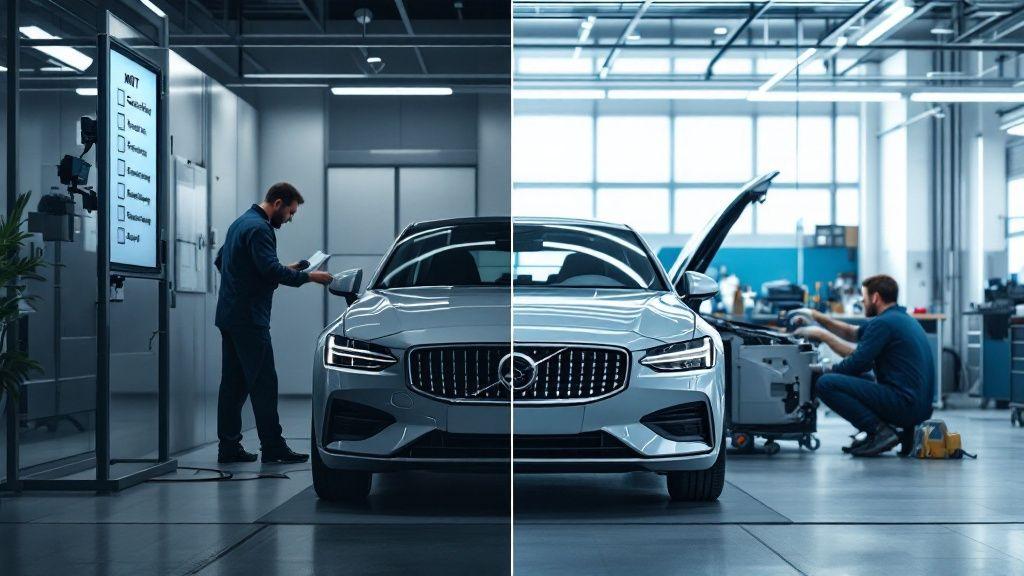
An MOT is a mandatory legal inspection that every car on UK roads needs to pass.Think of it as the government's way of ensuring your vehicle meets the absolute minimum safety and environmental standards to be considered roadworthy. A service, on the other hand, is a completely different beast. It's the proactive maintenance routine recommended by the people who built your car, designed to keep it running smoothly and catch problems before they start.
In short, an MOT is a pass-or-fail exam required by law. A service is a comprehensive health plan for your car.
MOT vs Service: A Quick Overview
It’s crucial for every UK driver to get their head around the difference between these two. While both are vital for your car, they have entirely different jobs. One is a legal hoop you have to jump through; the other is a smart investment in your car's future reliability and value.
A common and dangerous mistake is thinking a fresh MOT pass means your car is in perfect mechanical health. It isn't. An MOT certificate simply confirms your vehicle met the minimum safety standards on that specific day. It’s not a guarantee against future breakdowns.
An MOT is a snapshot in time, checking if your car is safe for the road right now. A service is forward-looking, focused on maintaining performance and preventing issues from cropping up over the next 12 months.
This distinction is massive. To make it crystal clear, let's break down the key differences at a glance before we dive deeper into what each process really involves.
Key Differences MOT vs Full Service
This table strips it back to basics, showing exactly where an MOT test and a full service part ways.
| Aspect | MOT Test | Vehicle Service |
|---|---|---|
| Purpose | Legal roadworthiness inspection | Proactive mechanical maintenance |
| Requirement | Mandatory by law | Manufacturer's recommendation |
| Outcome | Pass/Fail certificate | Maintenance and component replacement |
| Focus | Minimum safety & emissions standards | Vehicle health, efficiency & longevity |
As you can see, they serve completely different functions. The MOT is about compliance, whereas a service is about care and prevention.
Understanding the MOT Test: Your Legal Duty
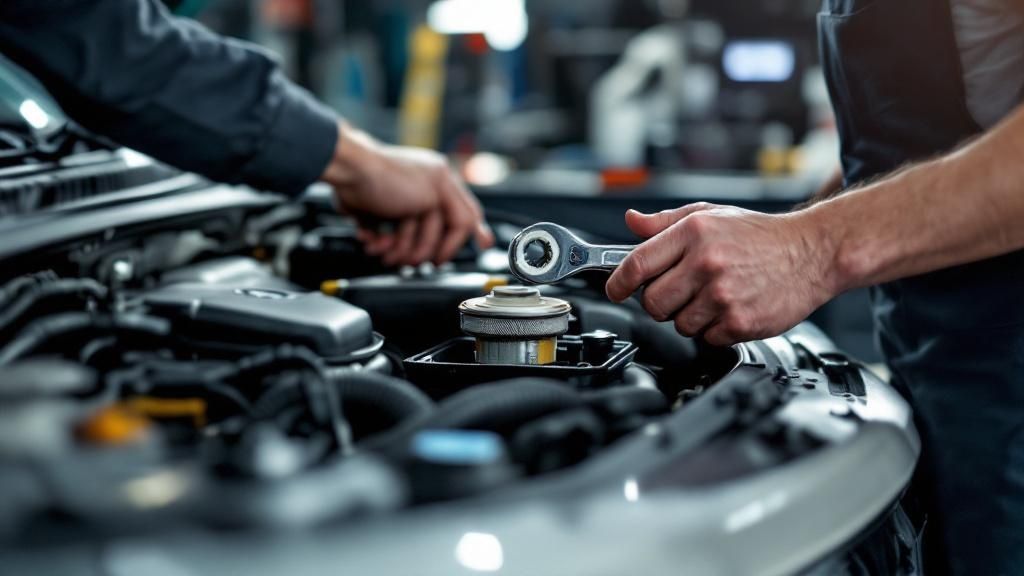
Let’s be crystal clear: the MOT isn’t a suggestion, it's a legal requirement for almost every vehicle over three years old on UK roads. It’s a government-mandated inspection designed purely to confirm that a car meets the minimum safety and environmental standards to be driven legally. Think of it as a crucial pillar of our national road safety framework.
First brought in back in 1960 for cars over 10 years old, the rules were tightened to the current three-year mark by 1967 because of shockingly high failure rates. And it's still just as relevant today. Government stats show that the first-time failure rate for cars and light vans is 31.1%, proving how vital it is for catching unsafe vehicles. You can dig into all the official MOT test data for Great Britain on the government's website.
What an MOT Inspector Actually Checks
The test is anything but random. Every MOT inspector follows a strict, non-negotiable checklist laid out by the Driver and Vehicle Standards Agency (DVSA). They methodically examine specific parts to make sure they're up to the minimum legal standard.
Key inspection areas include:
- Brakes: Performance, overall condition, and efficiency.
- Lights: Correct operation, colour, and headlight aim.
- Tyres and Wheels: Tread depth, condition, and security.
- Seatbelts: Proper function, condition, and solid anchorage.
- Body and Structure: No excessive corrosion or damage in critical areas.
- Exhaust and Emissions: Must meet strict environmental limits.
An MOT certificate simply confirms that on the day of the test, the vehicle met the minimum legal road safety and environmental standards. It is not a guarantee of mechanical soundness, nor does it mean the car will stay roadworthy for the next 12 months.
What an MOT Completely Ignores
This is where people often get caught out, and it’s the biggest difference between an MOT and a service. The MOT is not a mechanical health check. It turns a blind eye to the core components that determine your car's reliability, performance, and longevity.
An MOT will not inspect the:
- Engine
- Clutch
- Gearbox
- Engine oil level or condition
- Coolant levels
A car could sail through its MOT with a clean sheet but be running on critically low oil, setting it on a path to catastrophic engine failure just a few hundred miles later. This glaring omission is why you can never rely on an MOT certificate alone as proof of a car's health.
The consequences of getting this wrong are severe. Driving without a valid MOT can land you with a fine of up to £1,000, but more importantly, it will almost certainly invalidate your car insurance policy.
Exploring What a Vehicle Service Really Covers
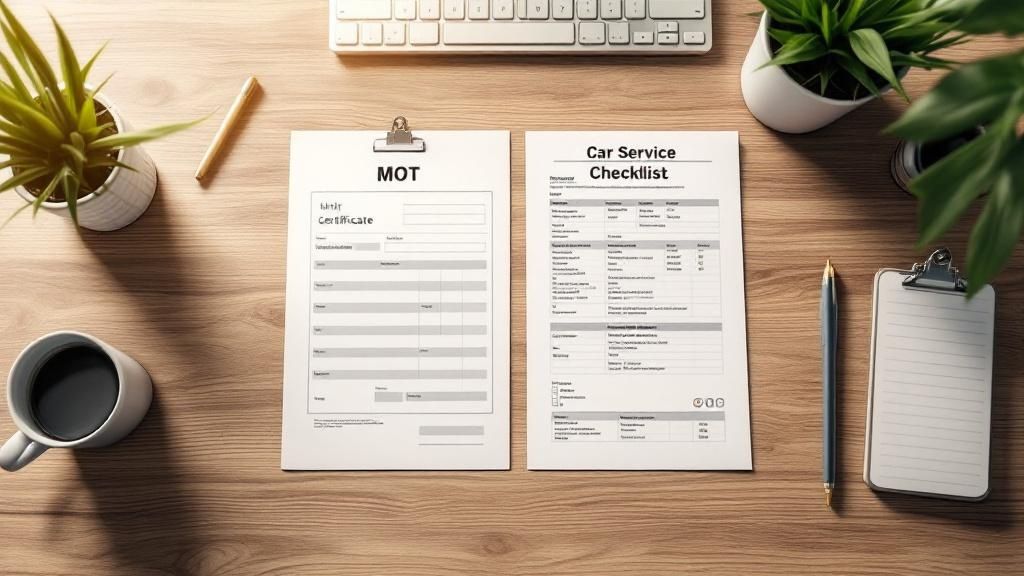
If an MOT is the legally required safety exam, think of a vehicle service as a proactive health plan designed by the people who made the car. This isn’t about just passing a test; it's about keeping the car's mechanicals in top condition, making sure it performs as it should, and ultimately, making it last longer. Getting to grips with the difference between an MOT and a service is key to understanding a vehicle’s real long-term value.
A service goes much deeper than the MOT checklist, looking into the engine, gearbox, and other complex systems that the MOT doesn't even touch. It’s all about prevention, aiming to spot wear and tear before it develops into a major fault and a surprise breakdown. Following the service schedule is also essential for keeping the manufacturer's warranty valid and protecting its resale value—a full service history is a huge plus for any potential buyer.
The Different Levels of Service
Not all services are the same. They're usually structured in tiers based on how old the car is or how many miles it has done. This ensures the vehicle gets the right level of attention at the right time. The three common types you’ll come across are:
- Interim Service: This is a basic check-up, typically recommended every six months or 6,000 miles. It mainly covers an engine oil and oil filter change, a top-up of essential fluids, and a thorough visual inspection of key components.
- Full Service: This is the one you’ll do annually or every 12,000 miles. It includes everything from the interim service but adds things like a new air filter and often a fuel filter, plus more detailed checks of the brakes, steering, and suspension systems.
- Major Service: Usually carried out every two years or 24,000 miles, this is the most comprehensive service. It covers everything in a full service and often includes replacing parts with a longer lifespan, such as spark plugs and brake fluid, as specified by the manufacturer.
A good way to think about it is this: an interim service is a quick health check, a full service is your annual physical, and a major service is like seeing a specialist. Each one has a crucial part to play in keeping the vehicle healthy for the long run.
A stamped service book is solid proof that a car has been looked after properly. This not only helps you avoid expensive, unexpected repair bills down the line but also boosts fuel efficiency and ensures the car runs as smoothly and reliably as the day it left the factory. It’s an investment, not just another bill to pay.
MOT vs. Service: A Head-to-Head on Scope, Cost, and Timing

To really get to grips with the difference between an MOT and a service, you have to put them side-by-side. Looking at what they check, how much they cost, and when they’re needed reveals just how different their purposes are.
The scope of an MOT is rigid, non-negotiable, and set by law. It’s a strict checklist focusing only on components critical for safety and emissions. An examiner has no wiggle room—they simply pass or fail parts like brakes, lights, and tyres against a minimum legal standard.
A service, on the other hand, is a proper health check. It goes far deeper, looking into the vehicle's mechanical and electrical systems, including the engine, gearbox, and fluid levels—all areas the MOT doesn't even touch.
Cost Structures: A Legal Cap vs. Market Rates
This massive difference in scope has a direct impact on the price. As a statutory inspection, the MOT's price is legally capped by the government. The maximum fee for a standard car (a Class 4 vehicle) is currently £54.85, though many garages will offer it for less to bring in customers for other work.
A vehicle service has no such price cap. The cost is set by the garage and depends on the type of service—interim, full, or major—and the vehicle itself. A basic service might start around £100–£200, but a major service on a high-end vehicle can easily top £400. That price reflects the detailed work, replacement parts, and fluids involved. If you're curious, you can learn about the MOT test's evolution on Kwik-Fit.com and see how things have changed over the years.
An MOT confirms your car was roadworthy on the day of the test; a service aims to keep it reliable and healthy for the year ahead. One is a snapshot of legal compliance, the other a long-term wellness plan.
Timing and Scheduling: Fixed Deadline vs. Flexible Maintenance
Finally, you have the timing, which couldn't be more different. An MOT has a fixed annual deadline tied to your vehicle’s registration date once it passes three years old. Let that date slip, and you can’t legally drive on public roads, barring a couple of very specific exceptions.
A service schedule is far more flexible and is usually guided by the manufacturer's recommendations. This is typically based on a combination of time and mileage—for instance, every 12 months or 12,000 miles, whichever comes first. While skipping it isn't illegal, sticking to the schedule is absolutely vital for keeping the vehicle healthy, protecting its warranty, and holding onto its resale value.
MOT Inspection vs Full Service Checklist
To really illustrate the gap between these two checks, let's break down what gets looked at. The MOT is all about safety and legality, whereas a service is about health and longevity.
| Component/Check | Included in MOT? | Included in Full Service? |
|---|---|---|
| Brakes (Pads, Discs, Fluid) | ✅ Performance & Condition | ✅ Performance, Condition & Fluid Change |
| Tyres & Wheels | ✅ Tread, Condition, Pressure | ✅ Tread, Condition, Pressure & Alignment |
| Lights & Indicators | ✅ Operation & Aim | ✅ Operation & Aim |
| Steering & Suspension | ✅ Condition & Security | ✅ Condition, Security & Lubrication |
| Seatbelts & Airbags | ✅ Security & Operation | ✅ Security & Operation |
| Exhaust Emissions | ✅ Meets Legal Limits | ✅ Visual Check & Emissions Test |
| Engine Oil | ❌ Not Checked | ✅ Drained & Replaced |
| Oil Filter | ❌ Not Checked | ✅ Replaced |
| Air Filter | ❌ Not Checked | ✅ Replaced |
| Fuel Filter | ❌ Not Checked | ✅ Replaced |
| Spark Plugs (Petrol) | ❌ Not Checked | ✅ Checked & Replaced |
| Coolant/Antifreeze Level | ❌ Not Checked | ✅ Checked & Topped Up |
| Battery Health | ❌ Not Checked | ✅ Tested & Checked |
| Gearbox Fluid | ❌ Not Checked | ✅ Checked & Topped Up |
| General Engine Health | ❌ Not Checked | ✅ Inspected for Leaks & Wear |
As you can see, a service covers everything in an MOT but goes much further, replacing essential fluids and filters to prevent future problems. They are two different jobs with two different goals.
Here's the rewritten section, crafted to sound like an experienced human expert in the motor trade:
Why Your Car Needs Both to Be Safe and Reliable
Thinking of an MOT and a service as an either/or choice is one of the most common and costly mistakes a car owner can make. They aren't interchangeable at all; they’re two sides of the same coin, both essential for keeping a vehicle safe, legal, and dependable. Getting your head around the difference is key.
Relying on just one leaves you with massive blind spots.
Picture this: a car sails through its MOT. The brakes, lights, and emissions are all within the legal limits, so it gets the pass certificate. But the MOT tester doesn't check the engine oil level. If it's dangerously low, that car is just a few hundred miles away from a seized engine, leaving the owner stranded with a repair bill that runs into the thousands. It happens more than you'd think.
Now, let's flip that scenario. A careful owner gets their car serviced right on schedule. The garage changes the oil, swaps out the filters, and gives the engine a clean bill of health. But they don't check the precise aim of the headlights, something a standard service might not cover but an MOT tester will examine closely. The result? A perfectly healthy car that fails its MOT and is technically illegal to drive.
An MOT is a snapshot in time. It confirms your vehicle meets the minimum legal safety standards required to be on the road today. A service is about looking ahead, keeping the car mechanically sound and reliable for the next year.
These examples really drive the point home. The MOT is your legal responsibility—a check to make sure your car isn't an immediate hazard to you or others. Regular servicing is your investment in the car's long-term health, helping you sidestep huge repair bills and making sure it doesn’t let you down when you need it most.
The Complete Car Care Formula
For a car to be genuinely safe and reliable, it needs both.
- The MOT's Role: Confirms the car is legally roadworthy and meets basic safety requirements.
- The Service's Role: Maintains mechanical health, optimises efficiency, and extends the car's life.
Skipping a service to save a bit of cash is a false economy. It almost always comes back to bite you with a much bigger bill down the line. At the same time, assuming a fresh service is a guaranteed MOT pass can lead to a frustrating and inconvenient failure. For real peace of mind, you need to treat them as a partnership.
MOT vs. Service: Your Questions Answered
Even when you know the difference between an MOT and a service, a few practical questions always pop up. Let's run through some of the most common queries from UK drivers, so you can handle your car's upkeep like a pro.
Can I Get an MOT and Service Done Together?
Absolutely, and it’s usually a brilliant idea. Booking your annual MOT and service for the same day is a massive time-saver, cutting down on trips to the garage. Many workshops will even offer a discount for booking them as a package, which is always a bonus.
Here’s a tip: when you book, be very specific. Ask for the service to be done before the MOT test. This gives the mechanic a chance to spot and fix any potential MOT fails—like a dodgy bulb or worn-out tyre—during the service, which seriously boosts your odds of passing the first time.
Does a New Car Need an MOT?
Nope. A brand-new car gets a pass for its first three years on the road. The first MOT isn't due until the third anniversary of its registration.
Don't mistake this for a three-year pass on maintenance, though. You absolutely must stick to the manufacturer's recommended service schedule right from the start. Skipping services won't just harm your car; it will almost certainly invalidate your warranty.
Will a Service Guarantee My Car Passes its MOT?
A service is great preparation, but it is not a guaranteed pass. A full service is all about checking the mechanical health and long-term condition of your car, and it does cover many of the same areas as the MOT.
But the MOT has its own set of very specific, legally-mandated checks that a regular service just doesn't cover. For example, a standard service won’t involve using specialist gear to test the precise alignment of your headlight beams or the exact level of your exhaust emissions—both are common reasons for a car to fail its MOT.
What Should I Do If My Car Fails its MOT?
If your car fails, the test centre will give you a VT30 certificate that lists all the problems, which are classed as either 'Major' or 'Dangerous'.
- Major Defects: You can't legally drive the car. The only exceptions are driving to a pre-booked appointment to get the faults fixed, or to another MOT test.
- Dangerous Defects: The car is considered a direct risk to road safety and cannot be driven at all until it's repaired.
Your best bet is usually to leave the car with the garage that did the test. They can carry out the repairs and then do a partial retest, which is often free or offered at a reduced price if it's done within 10 working days.
Article created using Outrank
Published by AutoProv
Your trusted source for vehicle intelligence